 Stars Near St. George
These are the questions we hear most from St. George locals and Zion-corridor travelers planning a Bryce Canyon stargazing night. If your question is not here, the booking page at Bryce Canyon Stargazing can help with tour-specific details.
About 125 miles — roughly a 2.5-hour drive. The fastest route is I-15 North to UT-20, then US-89 south to UT-12 East. The scenic alternative runs on UT-9 through Zion National Park and up US-89, which takes about 3 hours plus park traffic. Both routes, with seasonal timing for evening tours, are mapped out in the driving guide.
Yes, decisively. Both are certified International Dark Sky Parks, but Zion's 2,000-foot canyon walls block most of the sky from the canyon floor where visitors actually are. Bryce's amphitheater rim sits at 8,000 to 9,100 feet with horizon-to-horizon views and skies measured at limiting magnitude 7.4 — roughly 7,500 visible stars on a moonless night. The full breakdown is in Zion vs Bryce for stargazing.
Did You Know?
Summer monsoon storms often make the best nights — not the worst.
Bryce Canyon has well over 200 clear days a year. When summer monsoon storms do build in the afternoon (July–August), they typically dissipate by mid-evening — leaving behind exceptionally clean, transparent air that makes the stars look especially sharp.
No. Guided tours with Bryce Canyon Stargazing provide the telescopes, and guides handle aiming, tracking, and focusing between guests. No astronomy background is needed — the laser-guided constellation tour is designed to teach you the sky from zero.
Very much so. Tours involve no hiking, viewing spots are chosen for easy access, and the pace is relaxed. Kids who can comfortably reach a telescope eyepiece are routinely the most enthusiastic observers in the group. The one rule: dress them warmly — nights on the rim run 20 to 30 degrees colder than St. George.
Bryce Canyon enjoys well over 200 clear days a year, but weather happens. Tour operators track conditions closely and communicate honestly when a night is not workable, typically offering to reschedule. Worth knowing: summer monsoon storms usually build in the afternoon and clear by mid-evening, often leaving the air exceptionally clean for stargazing.
For the classic Milky Way experience: a clear night within a few days of a new moon between May and September, with July and August at the peak. But winter delivers the crispest air of the year, the Geminid meteor shower, and Orion over snow-dusted hoodoos. The month-by-month guide has the full table.
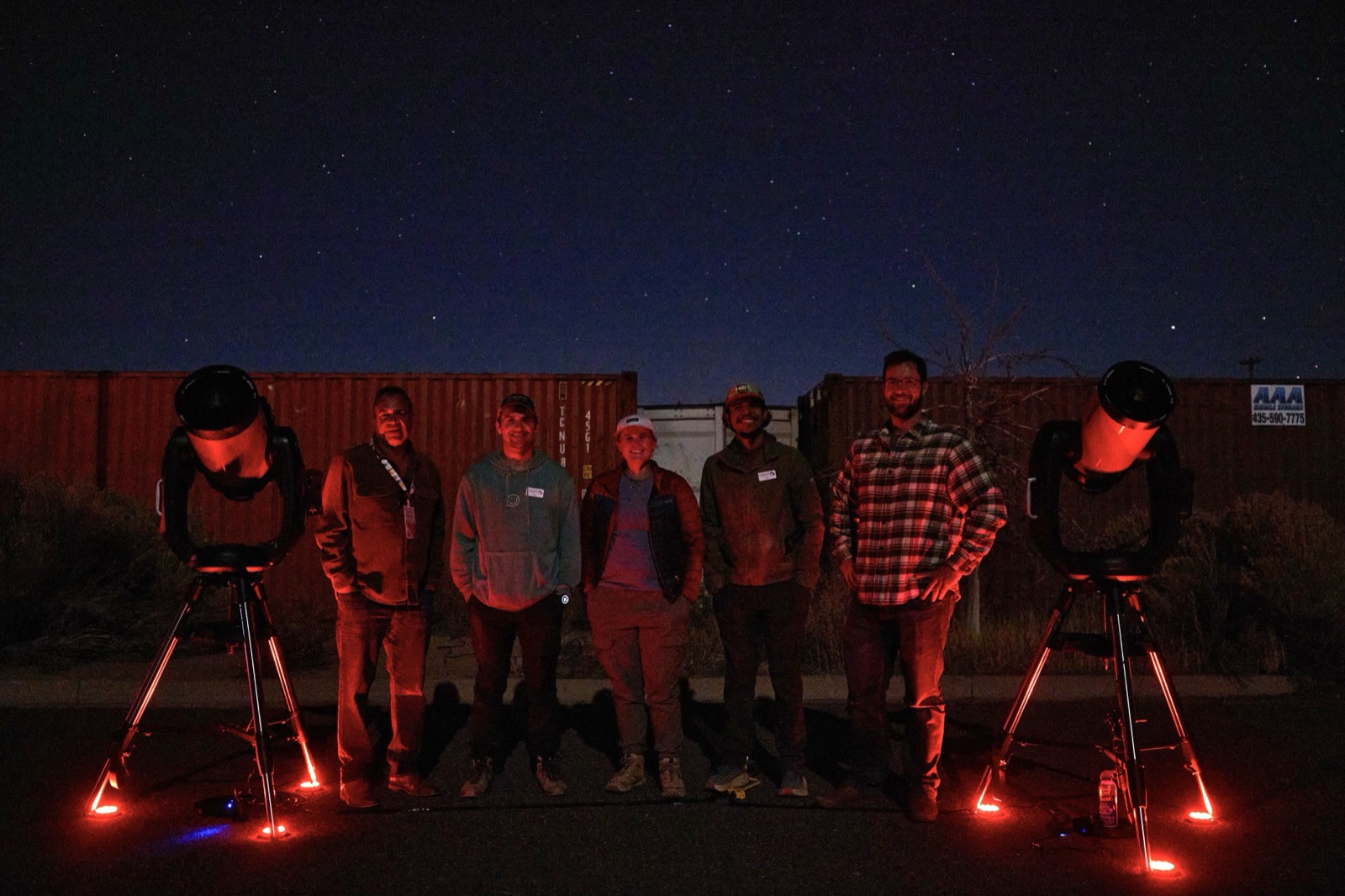
It changes the show rather than ruining it. A bright moon washes out the Milky Way and faint stars, but moonlight on the hoodoo amphitheater is a spectacle of its own, and telescope views of the moon, planets, and bright double stars remain excellent. For maximum star counts, book within about ten days of a new moon.
Colder than almost everyone expects. The rim sits at 8,000 to 9,100 feet, and nights run 20 to 30 degrees colder than St. George — a hot summer day in St. George can pair with a 45-degree night at Bryce. Dress as if it is two seasons later than the one you left: long pants, warm layers, and a real jacket even in July. Full clothing list in what to expect.
Did You Know?
The Bryce rim is typically 20 to 30 degrees colder than St. George — in every season.
The elevation difference is dramatic: St. George sits near 2,600 feet, while the Bryce rim reaches 8,000 to 9,100 feet. A 95-degree St. George afternoon can correspond to a 45-degree night on the rim. Stargazing is a standing-still activity, which makes cold feel colder. Dress like it is two seasons later than the one you left in.
Yes — plenty of locals do the round trip. The I-15 route home takes about 2.5 hours, so an 11 PM departure from Bryce puts you in St. George around 1:30 AM. Watch for deer and open-range cattle on US-89 and UT-12 after dark. The relaxed alternative: overnight in Bryce Canyon City, Tropic, or Panguitch and catch sunrise over the amphitheater before heading home.
Absolutely — the park is open around the clock with paid entrance, and any rim viewpoint is dark and beautiful at night. What a guided tour adds is the equipment and the understanding: telescopes you do not have to buy and haul, a laser-guided map of the sky, and a guide who knows what is rising, where to stand, and which objects will make you gasp. Seeing stars is free; understanding them is the upgrade.
Very. Bryce is about 1.5 to 2 hours from Zion's east entrance via the Zion–Mount Carmel Highway, US-89, and UT-12. The classic move is Zion by day, a late-afternoon drive east, dinner near Bryce, and a night tour — then either overnight near the park or return the next morning. The 3-day itinerary builds the whole trip around exactly this.
Warm layers (add hat and gloves outside midsummer), closed shoes, water, and a flashlight or headlamp with a red-light mode — white light destroys night vision for everyone nearby. Telescopes are provided. Photographers: a tripod and a camera with manual settings will get you Milky Way shots, and modern phone night modes do surprisingly well braced on a railing.
Most visitors feel only mild effects at 8,000 to 9,100 feet — a little breathlessness on stairs and faster dehydration. Stargazing is a standing-still activity, so exertion is minimal. Drink extra water during the day, go easy on alcohol before the tour, and take the amphitheater hike at an easy pace if you are doing both in one day.
Question answered? Night awaits.
Small-group guided stargazing tours at Bryce Canyon — telescopes, laser constellation tours, and the darkest accessible sky in the Southwest.
See What a Tour Is Like