 Stars Near St. George
If you have never been on a guided stargazing tour, it is reasonable to wonder what you are actually signing up for. Standing in the dark? Looking at dots? The reality is closer to a guided journey through the universe with the best possible backdrop — Bryce Canyon's magnitude 7.4 skies, where roughly 7,500 stars are visible on a moonless night. Here is how an evening with Bryce Canyon Stargazing typically unfolds.
Arrival: dusk on the plateau
Tours gather around nightfall — the exact time shifts with the season, from early evening in winter to well after 9 PM at midsummer (the best time to stargaze guide covers darkness times by month). If you are driving up from St. George that day, the driving guide has departure times that get you there with room for dinner.
As the light fades, something subtle happens that surprises almost everyone: the sky does not just get dark, it gets deep. Stars appear in layers — the bright ones first, then hundreds, then thousands, until the sky has texture. Your guide will use this transition deliberately, letting your eyes dark-adapt (about 20–30 minutes for full night vision) while setting the scene: where you are, what you are about to see, and why this particular plateau is one of the darkest accessible places in the country.
Did You Know?
Your eyes need 20 to 30 minutes to fully adapt to the dark — and it is worth the wait.
Full night vision takes about 20–30 minutes to develop. During this time, a guide introduces the sky and tells the story of the place. By the time the laser constellation tour begins, your eyes are ready to reveal structure in the Milky Way that was invisible five minutes before.
The laser-guided constellation tour
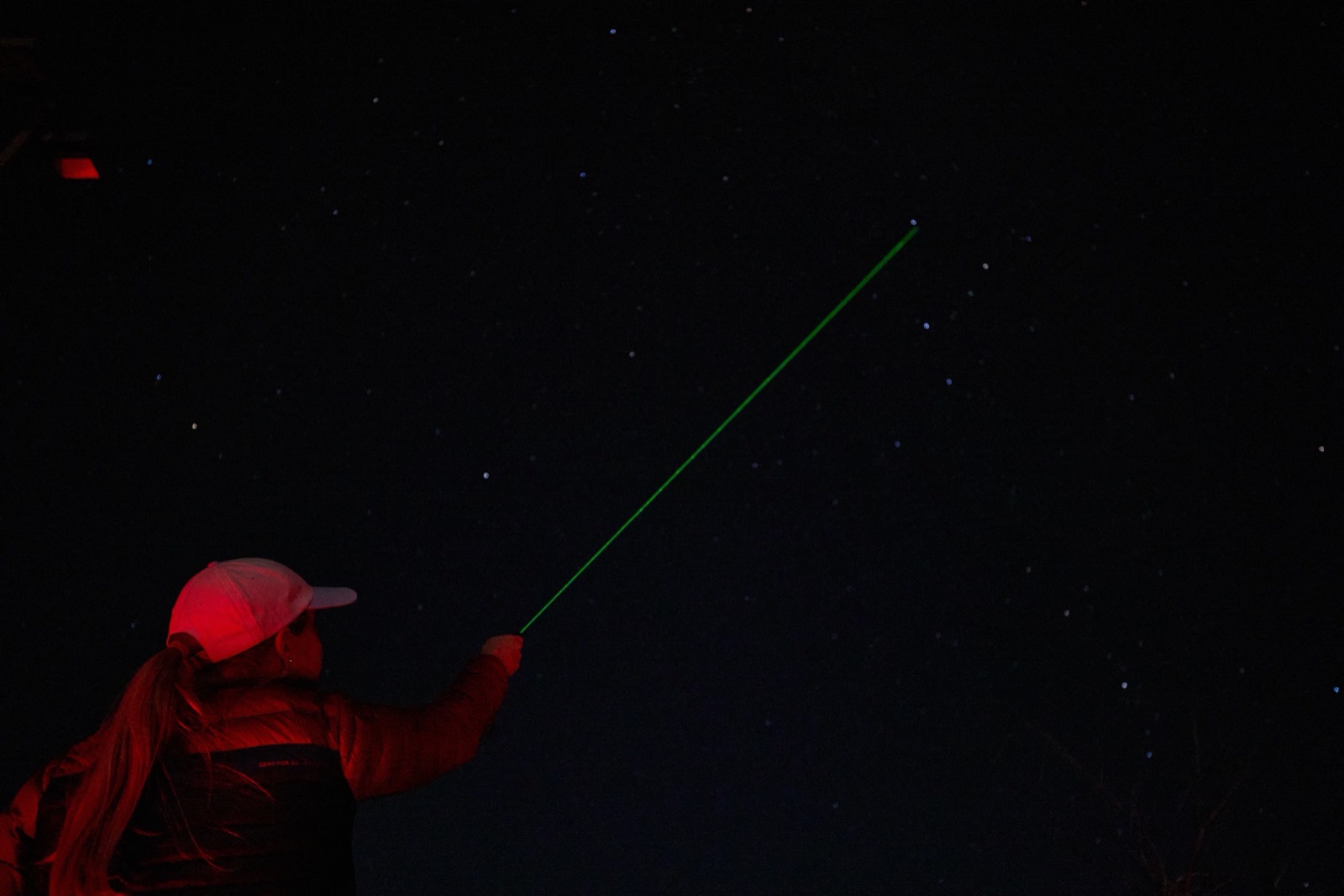
This is the part guests talk about afterward. Your guide uses an astronomy laser pointer that appears to physically touch the stars, tracing constellations across the sky so the whole group is looking at exactly the same thing. Instead of squinting at a star chart, you watch the sky organize itself in real time:
- The anchor constellations of the season — Scorpius and Sagittarius riding the summer Milky Way, or Orion commanding the winter sky.
- How to navigate: finding the North Star from the Big Dipper, following the ecliptic to spot planets, star-hopping to deep-sky landmarks.
- The stories — Greek, Indigenous, and modern — that humans have hung on these patterns for thousands of years.
- The structure of the Milky Way itself: at Bryce you can see the galaxy's dust lanes with your naked eye, and a guide can show you what you are actually looking at — the dark rifts, the bright star clouds, the direction of the galactic core.
Telescope time
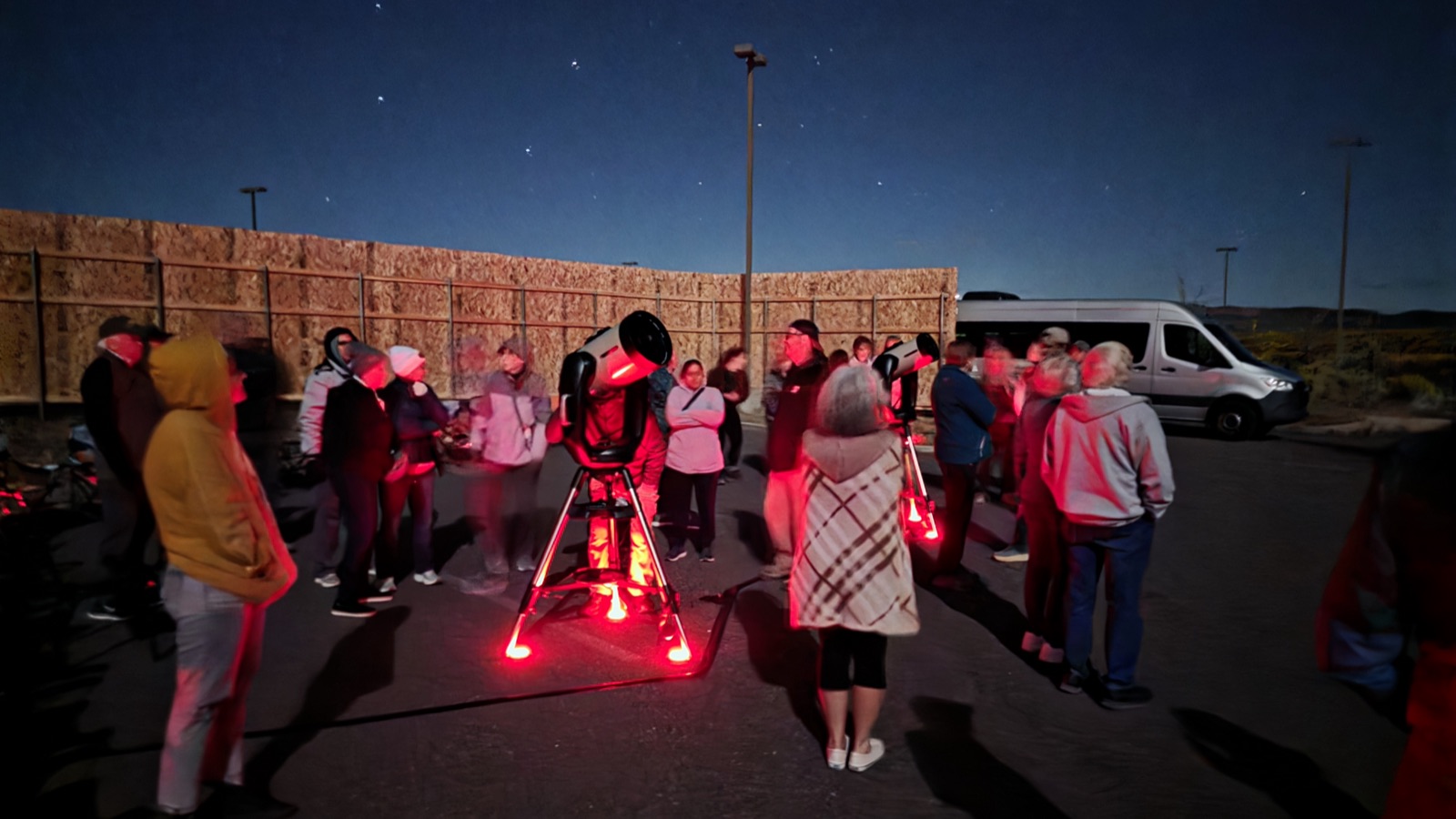
Quality telescopes turn the night from beautiful to astonishing. Depending on season and sky conditions, a night's targets typically include:
- Planets: Saturn's rings draw audible gasps every single night they are visible. Jupiter shows its cloud bands and four Galilean moons lined up like beads.
- The moon (when it is up): craters, mountain ranges, and the long shadows along the terminator line in crisp detail.
- Deep-sky objects: globular clusters that resolve into thousands of pinpoint stars, glowing nebulae like the Ring or the Orion Nebula, and — on dark nights — the Andromeda Galaxy, whose light has traveled 2.5 million years to reach your eye.
- Double stars: stars that look single to the naked eye and split into contrasting colored pairs in the eyepiece, like Albireo's gold-and-blue duo.
Guides handle all the equipment — finding, tracking, and refocusing between guests — so you spend your time looking, not fiddling. No experience is needed, and kids who can comfortably reach an eyepiece tend to be the most enthusiastic observers of the night.
The hoodoos after dark
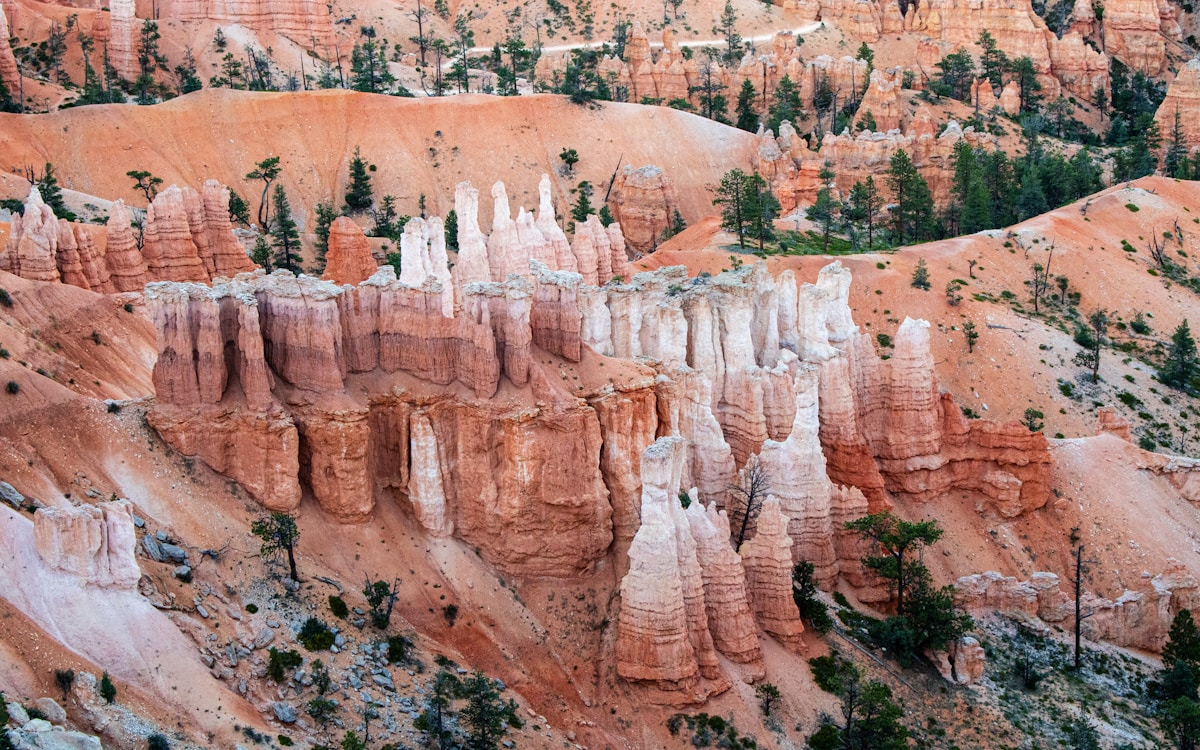
Here is what no other dark-sky destination can offer: the foreground. Bryce's amphitheater holds thousands of stone spires, and at night they become silhouettes under the stars — jagged, strange, and beautiful. On moonlit nights the hoodoos glow a pale orange; on moonless nights they read as dark sculpture beneath the Milky Way. It is the reason photographers travel from around the world for this exact view, and it is why Bryce beats Zion for stargazing: the high open rim gives you the whole sky and a one-of-a-kind landscape below it.
Did You Know?
Bryce Canyon's hoodoos exist nowhere else on Earth in this concentration.
Bryce Canyon has the largest concentration of hoodoos on Earth. These irregular columns of soft pink, orange, and white limestone were carved by frost-heave cycles — the plateau freezes and thaws more than 200 times a year. At night, thousands of these spires become silhouettes beneath the Milky Way in a scene that exists nowhere else.
How to dress: the 8,000-foot rule
This is the most important practical section on this page. Bryce Canyon's rim sits at 8,000–9,100 feet, and high-desert air sheds heat fast after sunset. Nights at Bryce routinely run 20–30 degrees colder than St. George — a 95-degree St. George afternoon can correspond to a 45-degree Bryce night. Stargazing is a standing-still activity, which makes cold feel colder. Dress like it is two seasons later than the one you drove in from:
- Summer: long pants, closed shoes, a warm mid-layer, and a real jacket. A beanie lives in your bag and gets used more often than you would guess.
- Spring and fall: winter coat, hat, gloves, warm socks.
- Winter: full winter kit — insulated coat, base layers, insulated boots, gloves, hat. Properly dressed, winter nights are among the most spectacular of the year.
- Always: a headlamp or flashlight with a red-light mode (white light wrecks night vision for everyone around you), and water — high elevation dehydrates quietly.
Who tours are for
Everyone, genuinely. The pace is relaxed — gather, look up, take turns at the eyepiece, ask questions. No hiking is required, and viewing spots are chosen for easy access. Families, couples, photographers, and solo travelers all mix easily in a small group. If you have specific questions — kids' ages, accessibility, what happens if clouds roll in — the FAQ answers the things people most often ask before booking.
Ready to see it for yourself?
Small-group guided tours with telescopes and laser-guided constellation tours, under the darkest accessible sky in the Southwest.
Common Questions Before You GoOne last thing: the moment
Every guide will tell you about the same recurring moment. Somewhere in the first half-hour, a guest who has been politely interested suddenly goes quiet, head back, and says some version of "I had no idea." That is the magnitude 7.4 sky doing its work. Photos do not capture it; descriptions undersell it. It is the difference between knowing the universe is out there and standing inside it — and it is waiting 2.5 hours up the road from St. George.